Is a refurbished device worth buying? What the label does and does not promise
Refurbished has no federal definition for electronics in the US, so the written warranty — not the label — is the guarantee. Here is how to read one.
The decision in front of you is a $1,369 refurbished MacBook Pro against the same machine at $1,599 new — a $230 gap — and the question is what that gap actually buys you. The honest answer: the label “refurbished” buys you nothing by itself, because it has no federal definition for electronics, and the word on the listing is not the guarantee. The warranty document is. Read it before the discount number, and this purchase becomes one of the better deals in consumer electronics; skip it, and you are buying a word.
Short answer. A refurbished device is worth buying when three things are true at once: the seller identifies who refurbished it and what was tested or replaced; the written warranty or guarantee is stated before the sale and covers more than the return window; and the discount is large enough that the price gap exceeds what the shorter coverage could cost you in one repair. If any of the three is missing, treat the listing as an ordinary used-goods sale and price it accordingly.
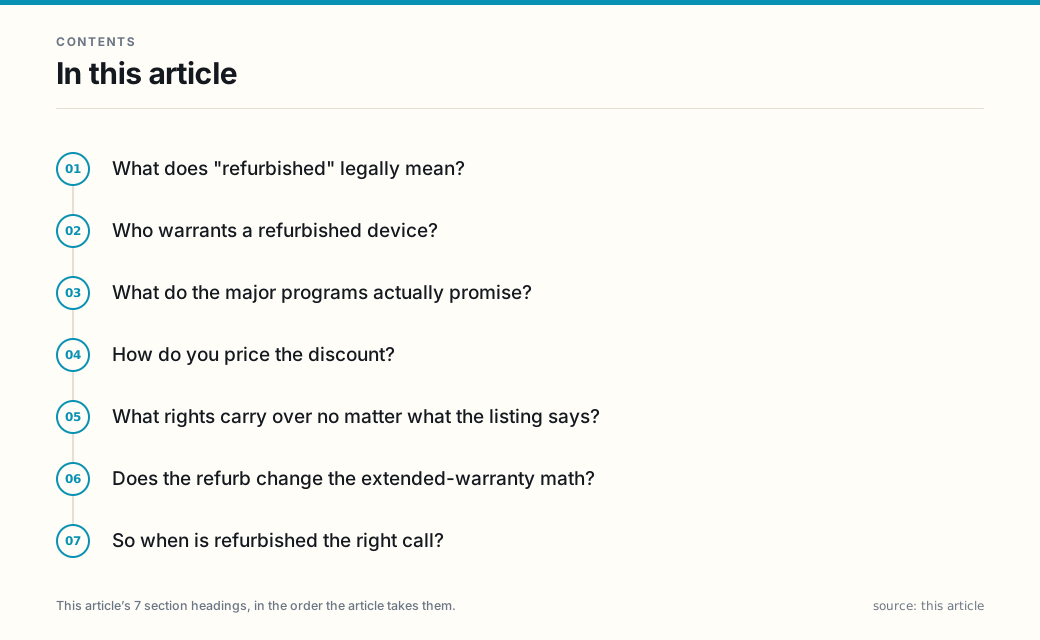
What does “refurbished” legally mean?
Less than you would hope. There is no federal definition of “refurbished” for consumer electronics — no statute, no FTC rule, no trade regulation that attaches a specific condition standard to the word on a phone or laptop listing. According to the FTC’s own consumer guidance from 2003, “Words like ‘refurbished,’ ‘vintage,’ or ‘close out’ may indicate that the product is in less than mint condition” — a caution about interpretation, not a standard a refurbisher must meet.
The nearest thing the federal government has to a definition is the other way around: the FTC’s Guides for the Rebuilt, Reconditioned, and Other Used Automobile Parts Industry (16 CFR Part 20) do define when a part may be called “rebuilt” or “remanufactured,” and require that previously used parts be clearly identified as such in advertising, invoices and packaging. But the guides’ scope is parts “designed for use in automobiles, trucks, motorcycles, tractors, or similar self-propelled vehicles” (§ 20.0(a)). Your phone is not covered. The precision exists for alternators; for electronics, the label is a seller’s characterization.
Two consequences follow, and both favor the careful buyer:
- The label tells you nothing enforceable. What you can actually hold the seller to is whatever written warranty or guarantee accompanies the sale, the return policy, and the implied warranties your state’s law gives you.
- Misdescribing the condition is still illegal. The absence of a definition does not license lying. Under Section 5 of the FTC Act, representing that a used device is in a condition it is not — “works like new” when it does not — is a deceptive practice regardless of what word the listing uses. The word “refurbished” is not a claim you can enforce; “professionally inspected and tested” is a claim the FTC can.
Who warrants a refurbished device?
The same body of law that warrants a new one, in most respects. This is the part buyers get wrong: they assume a refurbished sale is a legal category with weaker protection. It is not a distinct category at all.
Written warranties. If the refurbished device comes with a written warranty — Apple’s one-year coverage, a refurbisher’s 90-day warranty — the Magnuson-Moss Warranty Act applies to it exactly as it would to a new product. The warranty must be available for you to read before you buy (16 CFR Part 702, for products costing more than $15). It must be designated “full” or “limited” (15 U.S.C. § 2303(a)), and only a “full” warranty carries the federal minimum duties: remedy within a reasonable time and without charge, and a refund or free replacement after a reasonable number of repair attempts (§ 2304(a)). A refurbisher’s 90-day “limited warranty” can exclude nearly anything it states clearly; a full warranty cannot.
Implied warranties. The FTC’s Businessperson’s Guide to Federal Warranty Law is unusually blunt on this point: “Merchants of used goods also give implied warranties.” The warranty of merchantability — the unspoken promise that a device a merchant sells will do what such a device is supposed to do — attaches to a refurbished sale the same as a new one (UCC § 2-314, as adopted with state variations).
“As is.” A seller can often escape the implied warranties by selling “as is” — “in most, but not all states,” in the FTC guide’s own words, and only if the disclaimer is clear and conspicuous, generally in writing. The marketplace listing that reads “sold as-is, no returns” is attempting exactly that disclaimer. Whether it works depends on your state, and the variation is not subtle:
- In most states, “as is” or “with all faults” language, plainly presented, excludes the implied warranties (UCC § 2-316(3)).
- In California, an “as is” sale of consumer goods is not effective to disclaim the implied warranty of merchantability unless a conspicuous writing attached to the goods tells the buyer before the sale, in simple language, that the goods are sold as is, that the entire risk of quality and performance is with the buyer, and that the buyer assumes the entire cost of servicing or repair (Cal. Civ. Code § 1792.4(a)); mail-order catalogs must carry that writing for each item (§ 1792.4(b)). California attaches an implied warranty of merchantability to every retail sale of consumer goods in the state (§ 1792).
There is one rule that protects every refurb buyer in every state, and it is the single most useful sentence in this article: a seller that gives you a written warranty, or sells you a service contract at the sale or within 90 days afterward, cannot disclaim the implied warranties at all (15 U.S.C. § 2308(a)). The “certified refurbished, one-year warranty” listing and the “as is” listing are not just different levels of comfort — under federal law the first one cannot be an as-is sale.
What do the major programs actually promise?
Program terms are set by the vendor and can change, so these are snapshots — both retrieved November 6, 2026.
Apple Certified Refurbished. Apple’s refurbished storefront states its products “include a one-year warranty, full functional testing, and savings up to 15%.” The 15% is Apple’s ceiling, not a floor: the sample listing on that page — a refurbished 14-inch MacBook Pro — showed $1,369 against a “was” price of $1,599, which is $230, or about 14.4%. Two things are notable for the general case: the coverage term the program leads with is one year, and the claimed discount is bounded. When the largest vendor program tops out around 15%, a listing claiming 50% off with the same warranty should prompt the question of who is doing the warranting.
Amazon Renewed. Amazon’s program terms describe Renewed products as “professionally inspected, tested, and cleaned” by Amazon-qualified suppliers, with batteries exceeding 80% of original capacity and accessories that may be compatible rather than original. Eligible Renewed purchases carry the Amazon Renewed Guarantee: a replacement or refund within 90 days of receipt if you are not satisfied — one year for Renewed Premium products. Separately, Amazon requires Renewed sellers to provide at least a 90-day warranty on Renewed products in North America. And note the boundary in Amazon’s own returns policy: “New, used, and refurbished products purchased from sellers other than Amazon.com are subject to the returns policy of the applicable seller.” The marketplace’s most consumer-friendly terms apply to the program it runs, not automatically to every refurb listing on the site.
The battery detail deserves its own sentence in your checklist. A refurbished phone with a five-year-old battery is a device you will pay to repair soon; 80% of original capacity is the Amazon program’s line, and it is a number worth demanding from any refurbisher — in writing — rather than assuming.
How do you price the discount?
Not by comparing refurb prices to each other. The comparison that decides this purchase is discount versus coverage, and it is arithmetic you can do at the listing.
- Start with the real gap. Use the price against the same configuration new, not against a higher-trim model. The Apple example is the honest form: $1,599 − $1,369 = $230.
- Price the coverage difference in days, then dollars. If the refurb carries a 90-day guarantee where the new unit carries a one-year warranty, you are accepting 275 uncovered days. Ask what one repair in that window would cost — a screen, a battery, a charging port — and put that number next to the discount.
- Subtract the risk of the label. If the seller will not state who refurbished the unit, whether the battery was replaced, or whether it was wiped and de-activated from the previous owner’s account, the discount must cover all of that uncertainty, and it usually does not.
- Weigh what the warranty excludes, not just how long it lasts. A “limited” refurb warranty that excludes cosmetic wear, battery degradation, and accidental damage may be thinner than its 12 months suggests. The exclusions, not the duration, decide what the guarantee is worth.
A device is a good refurbishment buy when the discount clears the coverage gap with room to spare and the program’s terms are stated before checkout. It is a bad buy when you are being asked to accept an undefined label and a short guarantee and a marketplace seller whose own return policy is the only recourse.
What rights carry over no matter what the listing says?
Four, and none of them requires the listing to be honest about anything.
- Pre-sale disclosure. The warranty terms must be available to read before you buy (16 CFR Part 702). A refurb seller who cannot produce the warranty document before payment is telling you what its coverage is worth.
- The 30-day shipping rule. For any online order — refurb included — the seller must ship within the time it stated, or within 30 days after receiving a properly completed order if it stated none (50 days where you apply for credit at the time of order), under the FTC’s Mail, Internet, or Telephone Order Merchandise Rule (16 CFR § 435.2(a)). If it cannot, it must offer a new date you can accept or cancel and refund promptly (§ 435.3).
- No tie-ins. A warrantor cannot condition warranty coverage on your using its brand of repair service, unless it provides that service free under the warranty or has an FTC waiver (15 U.S.C. § 2302(c)). The refurbished phone repaired by an independent shop is not thereby outside its warranty. How far repair rights reach is its own subject — see the right to repair, explained.
- A courthouse. A breach of a warranty or guarantee on a refurbished device is a dispute sized for small claims court, and a dated written demand before filing is what makes the file readable when you get there.
Does the refurb change the extended-warranty math?
It changes it enough to matter. A service contract sold on a refurbished device is governed by the same law as one sold on a new device — it is a service contract, not a warranty, and the distinction decides what the plan owes you (the full breakdown is here). What the refurb changes is the baseline: the device has already accumulated its first owner’s wear, and the plan’s price has not dropped to reflect it. A plan priced for a new device covering a used one is a worse bet than either alone. And under § 2308(a), if the seller writes you a warranty and then sells you the plan within 90 days, the implied warranties stay in force — one more reason to buy the plan, if you buy one, from the same seller in the same transaction.
So when is refurbished the right call?
Buy refurbished when the listing survives five questions, each answerable in writing before payment: Who refurbished it — the manufacturer, an authorized program, or a third party? What was tested, repaired, or replaced, including the battery? Who honors the warranty, and for how long — 90 days, one year? What does the return window cover, and who pays return shipping? And what is the state of the implied-warranty disclaimer — is there a written warranty (which by federal law preserves the implied warranties under § 2308), or an “as is” sale your state may or may not enforce?
Skip it when the discount does not clear the coverage gap; when the seller will not name the refurbisher or put the battery condition in writing; when the device is near the end of its software support life; or when the “warranty” is a marketplace seller’s discretionary return policy rather than a written guarantee.
The pattern behind all of it is one sentence long: in US consumer electronics, “refurbished” is an undefined marketing word — the FTC’s own definitional guides stop at automobile parts — so the enforceable promise is the written warranty, the return policy, and the implied warranties your state preserves, and every one of those is readable before you pay.
This article describes US federal statutes and regulations and California law as one state example; warranty law varies by state, program terms above were current on November 6, 2026 and can change, and nothing here is legal advice about a specific purchase.
Frequently asked questions
- Is 'refurbished' a legally defined term for electronics in the US?
- No. There is no federal definition of 'refurbished' for consumer electronics. The FTC guide that comes closest — and even there the precision attaches to 'rebuilt' and 'remanufactured' — is the Guides for the Rebuilt, Reconditioned, and Other Used Automobile Parts Industry (16 CFR Part 20), and its scope is limited to parts designed for automobiles and similar vehicles — not phones, laptops or consoles. The FTC's own shopping guidance has said that words like 'refurbished' or 'close out' may indicate the product is in less than mint condition, which is a caution, not a standard.
- Do implied warranties apply to refurbished electronics?
- Generally yes. The FTC's Businessperson's Guide to Federal Warranty Law states plainly that 'merchants of used goods also give implied warranties.' A seller can often sell 'as is,' but only by clearly and conspicuously disclaiming the implied warranties, generally in writing — and under 15 U.S.C. § 2308 it cannot disclaim them at all if it also gives a written warranty or enters a service contract at the sale or within 90 days afterward. How much the disclaimer has to say varies by state.
- What warranty comes with Apple Certified Refurbished and Amazon Renewed products?
- As of November 6, 2026: Apple's refurbished storefront states its Certified Refurbished products include a one-year warranty, full functional testing, and savings up to 15%. Amazon's Renewed program backs eligible products with the Amazon Renewed Guarantee — a replacement or refund within 90 days of receipt (one year for Renewed Premium) — and states Renewed batteries exceed 80% of original capacity. These are program terms, not legal minimums, and they can change.
- The online seller says my refurbished order will 'ship soon' and it doesn't. What can I do?
- The FTC's Mail, Internet, or Telephone Order Merchandise Rule (16 CFR Part 435) requires the seller to ship within the time stated in its solicitation, or within 30 days after receiving a properly completed order if no time is stated (50 days if the buyer applies for credit at the time of order). If the seller cannot ship in time, it must offer a revised date the buyer can accept, or cancel the order and refund promptly.
- Does 'certified refurbished' mean the manufacturer certified it?
- Not necessarily. The certification is only as good as the party standing behind it, and on a marketplace that party may be a third-party seller rather than the manufacturer. Ask who performed the refurbishment and who honors the warranty, and note that Amazon's own returns policy says used and refurbished products bought from sellers other than Amazon.com are subject to the returns policy of the applicable seller.
- Can a warrantor refuse warranty service on a refurbished device because another shop repaired it?
- For a written warranty, no. 15 U.S.C. § 2302(c) bars conditioning a written or implied warranty on the buyer's using any article or service identified by brand, trade or corporate name, unless the item is provided free under the warranty or the FTC has granted a waiver. The same rule protects buyers of refurbished goods as buyers of new ones.
Sources
Each source is a primary or official reference, checked before publication. Links open the original.
- Federal Trade Commission, Businessperson's Guide to Federal Warranty Law — 'Merchants of used goods also give implied warranties. You can sell without implied warranties—"as is"—in most, but not all states. To sell "as is" you must clearly and conspicuously disclaim implied warranties, generally in writing. You cannot avoid implied warranties if you offer a written warranty on a consumer product.' (ftc.gov/business-guidance/resources/businesspersons-guide-federal-warranty-law)
- 16 CFR Part 20 — FTC Guides for the Rebuilt, Reconditioned, and Other Used Automobile Parts Industry: § 20.0(a) limits the guides to 'parts that are not new, and assemblies containing such parts, that were designed for use in automobiles, trucks, motorcycles, tractors, or similar self-propelled vehicles'; § 20.1(b) makes it deceptive to sell such a part without clearly and conspicuously disclosing in advertising, promotional literature, invoices and packaging that it is not new, using terms such as 'Used,' 'Reconditioned,' 'Rebuilt,' or 'Remanufactured'; § 20.3 restricts use of 'rebuilt' and 'remanufactured' to parts that have received the treatment the guides describe. No equivalent federal guide defines these terms for consumer electronics.
- FTC news release, 'Holiday Shopping Online?' (November 7, 2003) — the FTC's consumer shopping guidance states that 'Words like "refurbished," "vintage," or "close out" may indicate that the product is in less than mint condition, while name-brand items with "too good to be true" prices could be counterfeits,' and describes the mail-order shipping rule. (ftc.gov/news-events/news/press-releases/2003/11/holiday-shopping-online)
- 15 U.S.C. § 2303(a) — a written warranty on a consumer product must be conspicuously designated a 'full (statement of duration) warranty' or a 'limited warranty' depending on whether it meets the federal minimum standards of § 2304, unless exempted; 15 U.S.C. § 2304(a) — a full warranty requires remedy within a reasonable time and without charge, no limitation on the duration of implied warranties, no exclusion of consequential damages unless conspicuously disclosed, and a refund or free replacement after a reasonable number of repair attempts
- 15 U.S.C. § 2308(a) — no supplier may disclaim or modify any implied warranty if it makes a written warranty on the product, or if at the time of sale or within 90 days thereafter it enters into a service contract covering the product; § 2308(b) permits limiting implied-warranty duration to that of a reasonable written warranty where the limitation is conscionable, in clear and unmistakable language and prominent
- 15 U.S.C. § 2302(c) — no warrantor may condition a written or implied warranty connected with a consumer product on the consumer's using any article or service (including repair) identified by brand, trade or corporate name, unless provided free under the warranty or the condition is approved by the FTC under a waiver; § 2302(e) applies the section to consumer products actually costing the consumer more than $5
- 16 CFR Part 702 (Pre-Sale Availability of Written Warranty Terms) — warranty terms must be available for the consumer to read before sale, for consumer products costing the consumer more than $15; the FTC's consumer page 'Warranties' states: 'Whenever there's a warranty, the law says it must be available for you to read before you buy,' notes implied warranties 'cover products even when there isn't a written warranty, unless the seller gives a written notice that there's no warranty, or marks the product "as is," if your state law allows that,' and that implied warranties 'last as long as four years in some states'
- 16 CFR § 435.2(a) (Mail, Internet, or Telephone Order Merchandise Rule) — a seller may not solicit an order unless it has a reasonable basis to expect it can ship within the time clearly and conspicuously stated in the solicitation, or, if none is stated, within 30 days after receipt of a properly completed order (50 days where the buyer applies to the seller for credit at the time of order); § 435.3 requires the seller to offer a delay option or promptly cancel and refund when it cannot ship in time
- Uniform Commercial Code § 2-314(1) — a warranty that the goods shall be merchantable is implied in a contract for their sale if the seller is a merchant with respect to goods of that kind; UCC § 2-316(3) — language excluding or modifying implied warranties includes, unless the circumstances indicate otherwise, expressions like 'as is' and 'with all faults.' States adopt Article 2 with variations, so the disclaimer rules above are the majority pattern, not a uniform national rule
- California Civil Code § 1792 (Song-Beverly Consumer Warranty Act) — every sale of consumer goods sold at retail in California is accompanied by the manufacturer's and retail seller's implied warranty of merchantability, unless disclaimed in the manner the chapter prescribes; Cal. Civ. Code § 1792.4(a) — a sale on an 'as is' or 'with all faults' basis is not effective to disclaim the implied warranty of merchantability (or fitness, where applicable) unless a conspicuous writing attached to the goods informs the buyer before the sale, in simple and concise language, that the goods are sold as is, that the entire risk of quality and performance is with the buyer, and that the buyer assumes the entire cost of all necessary servicing or repair; § 1792.4(b) requires mail-order catalogs to carry that writing for each item offered
- California Civil Code § 1791.1 — defines the implied warranty of merchantability (goods pass without objection in the trade, are fit for ordinary purposes, are adequately contained, packaged and labeled, and conform to label promises) and of fitness; subsection (c) sets the duration of those implied warranties at between 60 days and one year following the sale of new consumer goods — the floor is written for new goods, and this article does not read it as fixing a duration for used-goods sales
- Apple Certified Refurbished storefront, retrieved November 6, 2026 — 'Apple Certified Refurbished products include a one-year warranty, full functional testing, and savings up to 15%' (apple.com/shop/refurbished); the same page listed a refurbished 14-inch MacBook Pro at $1,369 against a 'Was $1,599' price, a difference of $230
- Amazon Renewed, retrieved November 6, 2026 — program terms state Renewed products are 'professionally inspected, tested, and cleaned' by Amazon-qualified suppliers, carry batteries exceeding 80% capacity relative to new, may include compatible rather than original accessories, and are covered by the Amazon Renewed Guarantee: replacement or refund within 90 days of receipt (within 1 year for Renewed Premium); Amazon's seller documentation requires a minimum 90-day warranty on Renewed products in North America; Amazon's returns policy states 'New, used, and refurbished products purchased from sellers other than Amazon.com are subject to the returns policy of the applicable seller'
- 15 U.S.C. § 45(a)(1) (Section 5 of the FTC Act) — 'Unfair methods of competition in or affecting commerce, and unfair or deceptive acts or practices in or affecting commerce, are hereby declared unlawful'; § 45(a)(2) empowers the Commission to prevent persons, partnerships or corporations from using them. This is the basis for treating a condition misrepresentation — describing a used device as working like new when it does not — as deceptive, whatever word the listing uses
- Amazon Renewed seller documentation, 'Amazon Renewed Warranty Policies and The Renewed Guarantee' (Seller Central) — minimum required warranty period for Renewed products in North America is 90 days from the date of sale, honored and administered by the manufacturer, refurbisher, reseller or third-party provider; the Amazon Renewed Guarantee applies to Renewed products sold in the Renewed store except traditional wrist watches and Amazon devices